Guides · Your competition · 7 of 12
What people want from an app like yours, in your competitors' 1 and 2 star reviews
People write down what they expect from an app like yours, in public. The 1 and 2 star reviews say what is missing, the 5 star ones what yours has to match.
The app next to yours in search has thousands of ratings and a few hundred written reviews. You have read perhaps ten of them. Those reviews are a list of what its users wanted and did not get, written by the people you are trying to win over, and anyone can read it.
What can I learn from my competitors’ App Store reviews?
Two things, one from each end of the star scale.
- The 1 and 2 star reviews name what is missing or broken: the feature people expected, the bug that cost them a streak, the price that changed under them. Each one points at a gap another developer left open.
- The 4 and 5 star reviews name what people came for. That is the floor: what your app has to do as well before any gap matters.
One review is one person’s bad day. The signal is a word that comes back. When “sync” turns up in review after review, across versions and across months, a fix is overdue in that app. When the same word turns up in the reviews of three competing apps, the whole category leaves that need open.
Reviews belong to a country
A written review is public, and it belongs to the App Store of the country where it was written. Someone reading the German store sees German reviews. A competitor can be praised in one country and taken apart in another, because its translation, its price or its support differ there.
So a fair reading covers the countries you sell in, not only the one your Apple Account belongs to. Why your app ranks differently in every country shows how to look at another country’s store.
How to read them by hand
You need the competitor’s app ID: the number after “id” in its App Store address. Then there are two ways in.
- The store page. Open the competitor’s page in the App Store, scroll to Ratings and Reviews, and open the full list. It shows the reviews of your account’s country.
- Apple’s public review feed. Anyone can open it in a browser. For the United Kingdom store it is https://itunes.apple.com/gb/rss/customerreviews/page=1/id=1234567890/sortby=mostrecent/json, with the competitor’s ID after
id=and the country’s two letters afteritunes.apple.com/. It answers in a raw list written for programs, newest first, 50 reviews to a page. Changepage=1topage=2for the next fifty. Each review carries its stars (im:rating), its title, its text and the version it was written about (im:version). The feed reaches back about 500 reviews per country.
Then read with a pen. Keep a tally: one row for each thing a review names (a feature, a screen, a price, a device), and one mark each time a review with 1 or 2 stars names it. Nouns are what you are after. “Bad” and “annoying” say how someone felt. “Widget” and “export” say what they wanted.
What is normal: reviews arrive in bursts. A competitor’s release brings a wave within days, many of them about whatever the release changed. A word that leaps up in one week and fades the next was about that release. A word that stays through several releases is about the app.
What to do with the tally
Sort the tally by count. The top five words are your shortlist. Ask three questions of each one:
- Does your app already do it well? Then it is a line for your screenshots and your listing, written in the words those reviewers used. What your App Store screenshots should show covers where that line goes.
- Could you build it? Then it is a candidate for your next version, and you already know people who asked for it.
- Is it a cost every app in the category carries? A price rise or a new subscription shows up in 1 and 2 star reviews almost everywhere. Knowing it is there helps you price. It is not a feature.
Read the 4 and 5 star reviews the same way, faster. Where the praise names something your app lacks, that is the work before the work.
Do this today
Pick one competitor and one country, and give it half an hour.
- Open the competitor’s review feed for that country in a browser, page 1 and page 2.
- Read the reviews with 1 or 2 stars among those hundred. Write every thing they name in a tally, one mark per review.
- Circle the five words with the most marks, and write today’s date beside them.
Do the same for the same competitor in a month. The words still on top are the ones worth building for.
In ASOblick
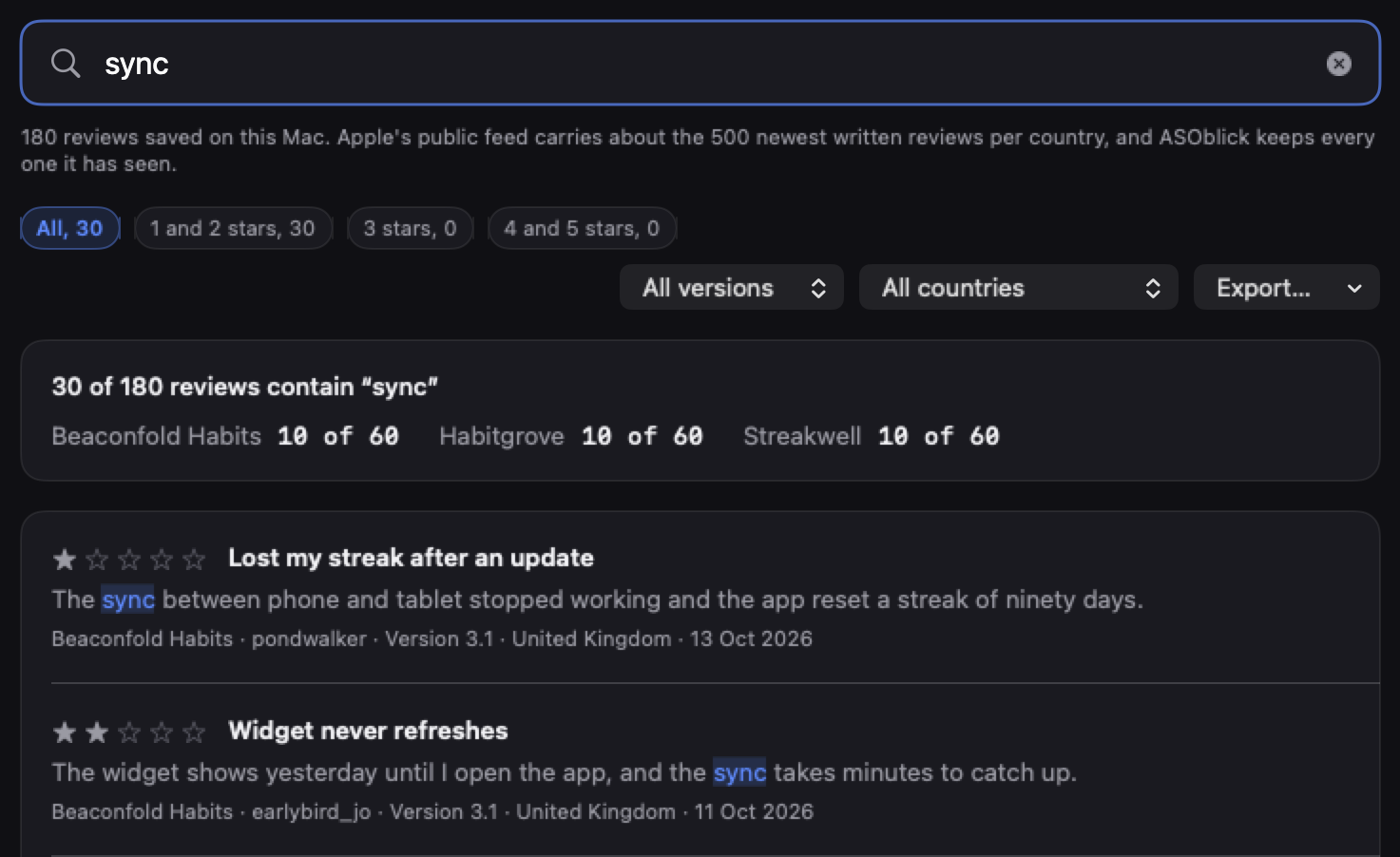
Track a competitor and ASOblick reads Apple’s public review feed for it once a day, in every country your app is checked in. The first read of a country takes up to 10 pages of 50, about the 500 newest written reviews. After that it reads the newest reviews each day until it meets one it already has. Every review it has seen stays on your Mac, so the record grows past the 500 the feed carries. Type a word in a competitor’s Reviews view, or in All Competitors, and the list shows every review whose title or text contains it, with how many of each competitor’s reviews hold it. Chips narrow the list to 1 and 2 stars, 3 stars, or 4 and 5 stars, and two menus narrow it to one version or one country. With nothing typed, a table lists the words used by a larger share of the 1 and 2 star reviews than of the 4 and 5 star ones, largest difference first, and a click on a word searches for it. Export saves the reviews on screen as a CSV file or as plain text. Your own Reviews page has the same search, chips, menus and table, as What your users are asking for in your App Store reviews shows.
The Competitors module is part of Max and Agency.
Next on the path: How to track what your competitors change in the App Store